
 EN
EN




Understanding how acoustic rock wool achieves its remarkable sound absorption properties requires examining the intricate relationship between its physical structure and acoustic physics. This mineral fiber insulation material has become a cornerstone solution in architectural acoustics, industrial noise control, and building construction, yet the mechanisms by which it transforms sound energy into heat remain fascinating from both engineering and scientific perspectives. The effectiveness of acoustic rock wool stems from its unique fibrous architecture, porosity characteristics, and material composition, all of which contribute to its ability to dampen sound waves across a broad frequency spectrum.
The science behind acoustic rock wool involves complex interactions between sound waves and the material's porous structure, where air molecules oscillate within narrow channels and around countless fibers, losing kinetic energy through viscous friction and thermal effects. Unlike dense barrier materials that reflect sound, acoustic rock wool operates as an absorptive medium, converting acoustic energy into minimal amounts of heat through a process that depends heavily on fiber diameter, density gradients, air flow resistivity, and overall porosity. Examining these structural characteristics reveals why acoustic rock wool performs exceptionally well in controlling reverberation, reducing noise transmission, and enhancing acoustic comfort in diverse applications ranging from recording studios to manufacturing facilities.
Fundamental Structure of Acoustic Rock Wool
Manufacturing Process and Fiber Formation
The creation of acoustic rock wool begins with basalt rock, diabase, or similar volcanic materials being melted at temperatures exceeding 1400 degrees Celsius, then spun or blown into fine fibers through centrifugal force or air jet processes. This high-temperature manufacturing approach produces fibers typically ranging from three to seven micrometers in diameter, creating a three-dimensional network with random orientation that maximizes surface area exposure to sound waves. The cooling and collection process allows manufacturers to control fiber length, thickness distribution, and initial arrangement patterns, all of which directly influence the final acoustic performance of the material. During production, binding agents are applied to maintain structural integrity while preserving the open porous architecture essential for sound absorption functionality.
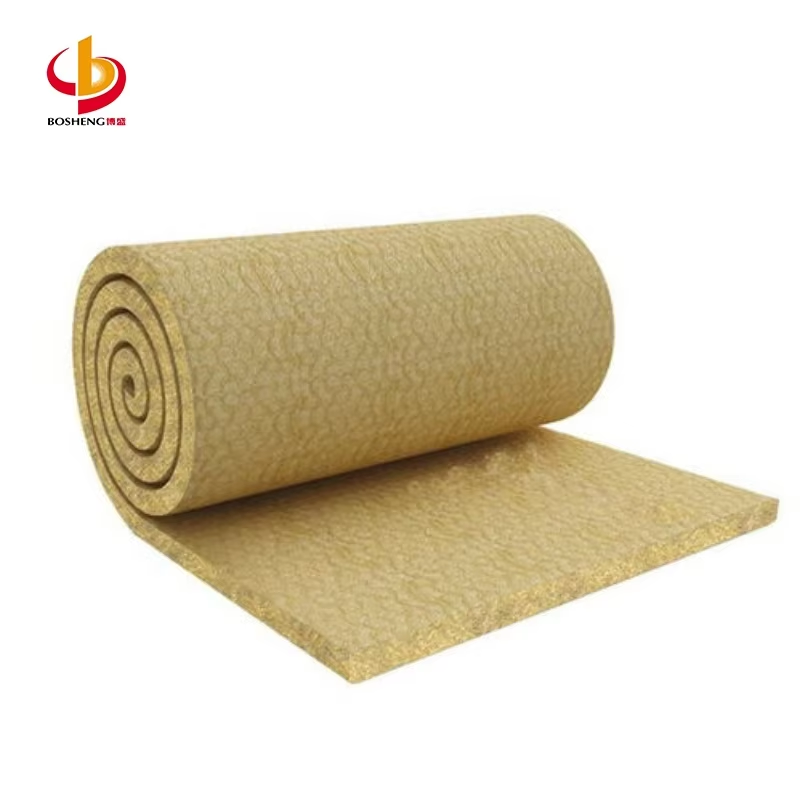
The fibrous matrix of acoustic rock wool exhibits a non-uniform structure characterized by interconnected air voids, tortuous pathways, and variable pore sizes that create ideal conditions for acoustic energy dissipation. Unlike materials with regular geometric pores, the random fiber orientation in acoustic rock wool generates a complex labyrinth through which sound waves must navigate, increasing the interaction time between air molecules and fiber surfaces. This structural randomness prevents the formation of direct sound transmission paths, forcing acoustic energy to undergo multiple reflections, refractions, and viscous losses as it penetrates the material depth. The resulting microstructure typically achieves porosity levels between ninety-five and ninety-eight percent, meaning the vast majority of the material volume consists of air trapped within the fiber network.
Density Variations and Acoustic Implications
Acoustic rock wool products are manufactured across a wide density range, typically from thirty to two hundred kilograms per cubic meter, with each density level offering distinct acoustic characteristics suited to specific applications. Lower-density acoustic rock wool features more widely spaced fibers with larger pore sizes, providing excellent high-frequency absorption but potentially limited low-frequency performance due to reduced air flow resistance. Medium-density formulations strike a balance between absorption efficiency and structural practicality, offering broad-spectrum performance suitable for general architectural applications where both sound absorption and moderate mechanical strength are required. Higher-density acoustic rock wool increases fiber packing and reduces average pore size, enhancing low-frequency absorption capabilities while maintaining effective performance across the audible spectrum.
The relationship between density and acoustic performance in acoustic rock wool follows principles described by porous absorber theory, where optimal sound absorption occurs when the material's air flow resistivity matches the characteristic impedance of air at specific frequencies. Engineers select density specifications based on target frequency ranges, with thicker, lower-density configurations preferred for controlling bass frequencies below two hundred Hertz, while thinner, higher-density options effectively manage mid and high frequencies. This density-dependent behavior allows designers to customize acoustic rock wool installations by layering different density grades, creating graded-density systems that provide uniform absorption across extended frequency bands. Understanding these density implications enables precise acoustic design where specific noise control objectives must be met within architectural or spatial constraints.
Fiber Geometry and Surface Area Considerations
The microscopic geometry of individual fibers within acoustic rock wool directly influences the material's capacity to interact with sound waves, with fiber diameter, length, and surface texture all contributing to overall acoustic effectiveness. Thinner fibers create more surface area per unit volume, increasing opportunities for viscous friction between oscillating air molecules and solid surfaces, which constitutes a primary mechanism of sound energy dissipation. The irregular surface texture of rock wool fibers, resulting from the rapid cooling process during manufacturing, further enhances acoustic interaction by creating microscale roughness that promotes additional energy losses through boundary layer effects. Fiber length affects the formation of the three-dimensional network structure, with longer fibers creating more connection points and a more resilient matrix that maintains acoustic properties under compression or vibration.
Advanced microscopy studies of acoustic rock wool reveal that the fiber network contains numerous contact points where fibers intersect or overlap, creating additional mechanisms for sound energy dissipation through friction at these interfaces. When sound waves induce vibration in the fiber structure, these contact points generate micro-movements that convert acoustic energy into heat through solid friction in addition to the viscous losses occurring in the air spaces. The geometric arrangement of fibers also creates a distribution of pore sizes ranging from several micrometers to several millimeters, enabling the material to interact effectively with sound waves across different wavelengths. This multi-scale pore structure ensures that acoustic rock wool maintains consistent absorption performance regardless of whether the incident sound consists of pure tones, complex music, or broadband noise.
Sound Absorption Mechanisms in Acoustic Rock Wool
Viscous Losses and Air Flow Resistance
When sound waves penetrate acoustic rock wool, they cause air molecules within the porous structure to oscillate back and forth in response to the alternating pressure fluctuations. These molecular oscillations occur within narrow channels between fibers where viscous forces dominate, creating friction between moving air and stationary fiber surfaces that converts kinetic energy into thermal energy. The magnitude of this viscous dissipation depends on the characteristic dimension of the air passages, with smaller pores generating higher flow resistance and greater energy conversion per unit depth of material. Acoustic rock wool achieves optimal viscous losses when its air flow resistivity falls within the range of five thousand to fifty thousand Pascal-seconds per square meter, a specification that manufacturers control through density and fiber diameter selection.
The concept of air flow resistivity in acoustic rock wool relates directly to how easily air can move through the material under a pressure gradient, serving as a fundamental parameter for predicting acoustic absorption performance. Materials with excessively low flow resistivity offer insufficient resistance to molecular motion, allowing sound waves to pass through with minimal energy dissipation, while materials with excessively high resistivity reflect sound at the surface rather than allowing penetration and internal absorption. The fibrous structure of acoustic rock wool naturally produces flow resistivity values within the optimal range for most architectural acoustic applications, making it inherently effective without requiring additional surface treatments or backing layers. Engineers use flow resistivity measurements to specify appropriate acoustic rock wool products for specific noise control scenarios, ensuring that the material's internal structure matches the acoustic impedance requirements of the application.
Thermal Effects and Energy Conversion
Beyond viscous friction, acoustic rock wool dissipates sound energy through thermal exchange processes that occur when air undergoes rapid compression and expansion cycles within the porous structure. During the compression phase of a sound wave, air temperature increases slightly, and during expansion, temperature decreases, creating temperature gradients between the air and surrounding fibers. Heat transfer between the oscillating air and the thermally stable fiber network represents an irreversible process that removes energy from the acoustic wave, contributing to overall sound absorption. The effectiveness of this thermal mechanism increases with frequency because higher-frequency sounds involve more rapid compression-expansion cycles, allowing less time for thermal equilibrium and thus creating larger temperature differentials.
The thermal properties of acoustic rock wool itself influence this energy conversion process, with the material's relatively low thermal conductivity helping to maintain temperature gradients between air and fibers. The large surface area provided by the dense fiber network ensures extensive contact between oscillating air masses and solid surfaces where thermal exchange can occur. While thermal losses typically contribute less to overall sound absorption than viscous effects in acoustic rock wool, they become increasingly significant at higher frequencies where the characteristic dimensions of pores approach the thermal boundary layer thickness. Understanding both viscous and thermal mechanisms provides a complete picture of how acoustic rock wool transforms acoustic energy across the full audible frequency range, from deep bass tones where viscous effects dominate to ultrasonic frequencies where thermal effects play larger roles.
Structural Damping and Fiber Vibration
In addition to air-based dissipation mechanisms, acoustic rock wool exhibits structural damping properties that contribute to sound absorption, particularly at lower frequencies where fiber vibration becomes significant. When sound waves impinge on acoustic rock wool, they not only cause air particle oscillation but also induce vibration in the fiber network itself, especially in lower-density configurations where fibers have more freedom to move. These fiber vibrations dissipate energy through internal friction within the mineral fibers and at contact points between intersecting fibers, adding another dimension to the material's acoustic performance. The random orientation and interconnected nature of fibers in acoustic rock wool creates a highly damped system where vibrational energy spreads rapidly through the network and converts to heat rather than transmitting through the material.
The contribution of structural damping to overall sound absorption in acoustic rock wool depends on installation conditions, with unfaced materials exhibiting more fiber mobility and thus greater structural losses compared to encapsulated or facing-covered products. When acoustic rock wool is compressed during installation or subjected to airflow pressure from sound waves, the fiber network deforms elastically, with hysteresis in the stress-strain relationship providing additional energy dissipation. This mechanical damping mechanism proves particularly valuable for controlling structure-borne vibration in building applications where acoustic rock wool serves dual purposes as both airborne sound absorber and vibration isolator. The combination of air-based viscous and thermal losses with solid-based structural damping makes acoustic rock wool a comprehensive acoustic treatment material capable of addressing multiple noise control challenges simultaneously.
Acoustic Performance Characteristics Across Frequencies
High-Frequency Absorption Behavior
Acoustic rock wool demonstrates exceptional absorption of high-frequency sounds, typically achieving absorption coefficients exceeding zero point nine for frequencies above one thousand Hertz in standard installation configurations. This outstanding high-frequency performance results from the short wavelengths involved, which means sound waves interact with numerous fibers and pores even within shallow material depths. At frequencies above two thousand Hertz, wavelengths become comparable to or smaller than the characteristic pore dimensions in acoustic rock wool, creating conditions where essentially every air molecule oscillation encounters a fiber surface and undergoes viscous dissipation. The random fiber orientation ensures that sound approaching from any angle encounters similar acoustic impedance and absorption characteristics, making acoustic rock wool an effective omnidirectional absorber for high-frequency noise.
The practical implications of this high-frequency effectiveness mean that relatively thin layers of acoustic rock wool, often just twenty-five to fifty millimeters thick, can dramatically reduce reverberation and control echo problems in rooms where speech intelligibility or music clarity is important. High-frequency absorption also addresses common industrial noise issues such as machinery whine, air leaks, and electronic equipment cooling fans, making acoustic rock wool valuable in manufacturing and technical environments. The consistency of high-frequency absorption across different acoustic rock wool densities provides designers with flexibility in product selection, allowing structural or thermal requirements to guide choices while maintaining confidence in acoustic performance. However, over-absorption of high frequencies relative to lower frequencies can create acoustically dead spaces that sound unnatural, necessitating careful design to balance absorption across the spectrum.
Mid-Frequency Absorption and Optimal Thickness
In the mid-frequency range from two hundred to one thousand Hertz, which encompasses much of human speech and musical fundamentals, acoustic rock wool performance depends significantly on material thickness and mounting configuration. At these frequencies, wavelengths range from approximately thirty-five centimeters to one point seven meters, requiring sufficient material depth to allow complete sound wave penetration and maximum interaction with the fiber structure. Acoustic rock wool installations of fifty to one hundred millimeters thickness typically provide absorption coefficients between zero point six and zero point nine across mid-frequencies, offering substantial acoustic control without requiring excessive material usage or building space. The gradual impedance transition from air to the porous material minimizes surface reflection in this frequency range, allowing sound energy to enter the acoustic rock wool where internal dissipation mechanisms can work effectively.
Optimizing mid-frequency absorption with acoustic rock wool often involves consideration of mounting methods, with air gaps behind the material enhancing performance by effectively increasing the acoustic thickness of the system. When acoustic rock wool is installed with a cavity backing, sound waves that pass through the material reflect from the rear surface and make a second pass through the fibers, doubling the opportunity for energy dissipation and significantly improving absorption, especially at the lower end of the mid-frequency range. Quarter-wavelength spacing proves particularly effective, where the air gap depth equals one-quarter of the wavelength of the target frequency, creating resonant absorption conditions that boost performance at specific frequencies. These installation techniques allow acoustic rock wool to achieve broad, uniform absorption across mid-frequencies that would otherwise require much thicker material layers, providing space-efficient solutions for acoustic treatment in buildings with limited depth available for ceiling or wall construction.
Low-Frequency Absorption Challenges and Solutions
Low-frequency sound absorption represents the most challenging aspect of acoustic control, and acoustic rock wool faces inherent limitations in this frequency range due to the long wavelengths involved, which can exceed several meters for frequencies below one hundred Hertz. Effective absorption of low-frequency sound typically requires material thickness approaching one-quarter of the wavelength, meaning that absorbing a fifty Hertz tone would theoretically require acoustic rock wool depths exceeding one meter in a simple unbacked configuration. Despite these fundamental physics constraints, acoustic rock wool can provide meaningful low-frequency absorption through strategic implementation approaches that maximize its effectiveness within practical thickness limitations. Higher-density acoustic rock wool formulations, typically above eighty kilograms per cubic meter, offer improved low-frequency performance compared to lighter alternatives due to increased air flow resistance that better matches the acoustic impedance of long-wavelength sounds.
Achieving acceptable low-frequency absorption with acoustic rock wool in real-world applications typically involves creating thick absorber systems, using multiple layers with varying densities, or implementing resonant backing cavities that enhance performance at specific problematic frequencies. Membrane absorbers combining acoustic rock wool with a limp mass layer create systems that resonate at tunable low frequencies, converting vibrational energy in the membrane into heat within the fiber matrix. Corner placement of acoustic rock wool treatments proves particularly effective for low-frequency control because sound pressure buildup at room boundaries creates optimal conditions for porous absorber effectiveness. While acoustic rock wool cannot match the low-frequency absorption of purpose-built bass traps or active noise control systems, its contribution to overall acoustic treatment remains valuable, especially when combined with other acoustic elements in comprehensive room design strategies that address all frequency ranges systematically.
Influencing Factors on Acoustic Rock Wool Performance
Material Thickness and Absorption Depth
The thickness dimension of acoustic rock wool installations directly determines the frequency range over which effective absorption occurs, with thicker materials providing improved performance at progressively lower frequencies. This relationship stems from the requirement that sound waves penetrate sufficiently into the absorptive medium to undergo complete energy dissipation, a process that requires physical depth comparable to the particle velocity amplitude distribution of the wave. For acoustic rock wool, absorption effectiveness begins when material thickness exceeds approximately one-sixteenth of the wavelength and reaches near-maximum efficiency when thickness approaches one-quarter wavelength. Practical installations typically range from twenty-five millimeters for targeted high-frequency absorption to three hundred millimeters or more for broad-spectrum control extending into low-frequency ranges, with the specific thickness selection balancing acoustic requirements against cost, space availability, and structural considerations.
The concept of effective acoustic thickness becomes important when considering the complete sound absorption system rather than just the acoustic rock wool layer itself. Air cavities behind acoustic rock wool, whether intentional design features or inherent to construction methods, add to the effective acoustic thickness by allowing sound waves to traverse the material multiple times through reflection at the backing surface. This principle enables relatively thin acoustic rock wool installations to achieve performance comparable to much thicker monolithic layers, provided the backing cavity dimensions are appropriate for target frequencies. Conversely, placing acoustic rock wool directly against rigid, impermeable surfaces limits its effectiveness to approximately half what would be achieved with standoff mounting, because particle velocity approaches zero at rigid boundaries, minimizing the viscous and thermal losses that depend on air movement within the porous structure.
Surface Treatments and Facing Materials
The exposed surface characteristics of acoustic rock wool significantly influence its acoustic performance, with unfaced materials generally providing maximum absorption but facing materials often required for aesthetic, durability, or air barrier purposes. Acoustically transparent facings such as thin nonwoven fabrics or perforated metal panels with adequate open area allow sound waves to enter the acoustic rock wool with minimal reflection, preserving most of the material's absorption capabilities while providing surface protection and finished appearance. The acoustic transparency of facing materials depends on their flow resistance relative to the acoustic rock wool itself, with optimal facings exhibiting much lower resistance to minimize impedance mismatch at the surface interface. Heavy or impermeable facings create significant acoustic barriers that reflect sound before it can penetrate the absorbent layer, drastically reducing effectiveness and potentially creating resonant cavity effects that cause unpredictable performance variations.
When protective facings are necessary for acoustic rock wool installations, designers must carefully specify facing materials with proven acoustic properties, typically requiring open area percentages exceeding twenty percent for perforated facings or air flow resistance below fifty Pascal-seconds per square meter for membrane facings. Glass fiber tissue, polyester scrims, and specialized acoustic fabrics provide surface protection while maintaining acoustic transparency, though even these materials introduce minor performance reductions compared to exposed acoustic rock wool. In applications where moisture resistance or rigidity is required, micro-perforated facings offer compromise solutions that provide some protective function while preserving reasonable acoustic access to the underlying fiber structure. Understanding the interaction between facing materials and acoustic rock wool enables designers to make informed trade-offs between acoustic performance and practical installation requirements, ensuring that protective measures do not inadvertently negate the acoustic benefits the material is intended to provide.
Installation Methods and Mounting Conditions
The manner in which acoustic rock wool is installed and mounted dramatically affects its real-world acoustic performance, with factors such as compression, edge sealing, and backing conditions all influencing sound absorption characteristics. Compression of acoustic rock wool during installation increases density and reduces porosity, potentially shifting the optimal frequency range downward while decreasing maximum absorption coefficients if over-compressed beyond design specifications. Manufacturers specify compression limits for their products, typically recommending installation densities within ten to twenty percent of the as-manufactured density to maintain acoustic properties while ensuring secure fitting. Edge treatments prove particularly important in ceiling and wall applications where gaps around acoustic rock wool panels can create flanking paths that allow sound to bypass the absorptive material, reducing system effectiveness and creating inconsistent acoustic conditions.
Mounting configurations for acoustic rock wool range from direct attachment to substrates for simple absorption applications to suspended cloud or baffle installations for architectural environments requiring aesthetic integration and maintained ceiling height. Mechanically fastened systems using specialized clips, adhesives, or friction-fitting within framing members each create different boundary conditions that affect acoustic performance, with particular attention required to avoid rigid coupling that dampens fiber mobility and reduces structural damping contributions. In ceiling applications, acoustic rock wool performance can be enhanced by maintaining air plenums above the material, effectively increasing acoustic depth and improving low-frequency absorption without additional material thickness. Understanding these installation variables allows acoustic designers and construction professionals to maximize acoustic rock wool effectiveness within real building assemblies, ensuring that predicted laboratory performance translates reliably to actual field conditions.
FAQ
What makes acoustic rock wool more effective than other insulation materials for sound absorption?
Acoustic rock wool achieves superior sound absorption compared to many other insulation materials due to its optimal combination of high porosity, appropriate air flow resistance, and extensive fiber surface area that maximizes viscous and thermal energy dissipation. The random three-dimensional fiber orientation creates a tortuous path for sound waves with no direct transmission routes, while the microstructure naturally produces flow resistivity values within the ideal range for acoustic applications without requiring additional treatment. Unlike closed-cell foam insulations that reflect rather than absorb sound, or fiberglass materials that may have insufficient density for low-frequency control, acoustic rock wool provides balanced performance across broad frequency spectrums. The material's non-combustible nature and dimensional stability also allow thicker installations without fire safety concerns, enabling the deep absorber configurations necessary for comprehensive acoustic control including lower frequencies.
How does acoustic rock wool density affect sound absorption at different frequencies?
Density variations in acoustic rock wool create distinct acoustic signatures optimized for different frequency ranges through their influence on air flow resistance and pore size distribution. Lower-density acoustic rock wool typically between thirty and sixty kilograms per cubic meter excels at high-frequency absorption due to larger pores and lower flow resistance that allows easy sound penetration, but may underperform at low frequencies where insufficient resistance fails to adequately couple with long-wavelength sounds. Medium-density formulations from sixty to one hundred kilograms per cubic meter provide balanced broad-spectrum absorption suitable for most architectural applications, offering effective performance from mid-frequencies through high frequencies with acceptable low-frequency contribution. Higher-density products above one hundred kilograms per cubic meter enhance low-frequency absorption by increasing flow resistance to better match the acoustic impedance of bass sounds, though excessively high densities can begin reflecting rather than absorbing sound at higher frequencies, requiring careful specification based on target noise characteristics.
Can acoustic rock wool maintain its sound absorption properties over time?
Acoustic rock wool demonstrates exceptional long-term stability of acoustic properties due to its inorganic mineral composition that resists degradation from moisture, biological growth, and normal environmental conditions. Unlike organic fiber absorbers that can decompose, compact under their own weight, or lose resilience over decades, the stone fibers in acoustic rock wool maintain their structural integrity indefinitely when properly installed and protected from physical damage or saturation. The binding agents used in manufacturing may experience minor changes over extended periods, but these typically affect mechanical properties rather than acoustic performance since sound absorption depends primarily on the fiber network geometry and porosity that remain stable. Regular acoustic testing of aged acoustic rock wool installations confirms sustained absorption coefficients comparable to new materials, making it a reliable choice for permanent architectural acoustic treatments where long-term performance predictability is essential for meeting building lifespan requirements.
Why does acoustic rock wool require specific thickness for effective low-frequency absorption?
Low-frequency sound absorption fundamentally requires substantial material depth because porous absorbers like acoustic rock wool work most effectively when thickness approaches one-quarter of the sound wavelength, and low-frequency sounds have wavelengths measured in meters rather than centimeters. At fifty Hertz, for example, the wavelength exceeds six meters, meaning optimal absorption would theoretically require acoustic rock wool thickness of one and a half meters, which is impractical for most applications. The physics behind this requirement relates to particle velocity distribution in sound waves, where maximum air movement occurs at distances from reflecting surfaces corresponding to odd multiples of quarter wavelengths, and porous absorbers depend on this air movement to generate the viscous and thermal losses that constitute sound absorption. While practical acoustic rock wool installations use thickness limitations between one hundred and three hundred millimeters for low-frequency control, these represent compromises that provide partial absorption rather than the near-complete absorption possible at higher frequencies where required depths align with available construction dimensions.
Table of Contents
- Fundamental Structure of Acoustic Rock Wool
- Sound Absorption Mechanisms in Acoustic Rock Wool
- Acoustic Performance Characteristics Across Frequencies
- Influencing Factors on Acoustic Rock Wool Performance
-
FAQ
- What makes acoustic rock wool more effective than other insulation materials for sound absorption?
- How does acoustic rock wool density affect sound absorption at different frequencies?
- Can acoustic rock wool maintain its sound absorption properties over time?
- Why does acoustic rock wool require specific thickness for effective low-frequency absorption?